From a solid billet of aluminum to a finished set — every stage, and why each one matters
The Short Answer
Why Forged?
A forged wheel starts life as a solid bar of aluminum, compressed under enormous pressure and then machined down to its finished shape. Nothing is ever molten, and nothing is poured.
That single difference drives everything else. Compression closes the microscopic voids that molten metal traps as it cools, so there are no internal weak points where a crack can start. It also forces the grain structure of the aluminum to follow the shape of the part rather than running randomly through it. Aligned grain and zero porosity mean the same load rating can be achieved with less material — which is why a properly engineered forged wheel carries more load at lower weight than its cast equivalent, with no welds and no casting imperfections.
We use advanced one-piece forging and aerospace-grade engineering to reach that result, and the process below is how it happens — sixteen stages, grouped into four phases, from raw bar stock to a packed crate.
6061-T6
Aerospace alloy
16
Production stages
8 hrs
Machining per wheel
JWL / TÜV
Standards
Construction Methods
Cast, Flow-Formed, Forged
Three ways to make a wheel, three very different starting points. The method sets the ceiling — engineering decides how close a wheel gets to it.
Cast
Molten aluminum poured into a mold and allowed to cool. The cheapest method to tool and the fastest to produce at volume.
Grain structure
Random
Porosity
Possible throughout
Strength
Baseline
Weight
Heaviest
Cost
Lowest
Flow-Formed
A cast center with the barrel spun and worked under pressure. A genuine improvement over cast, confined to the barrel.
Grain structure
Aligned in the barrel only
Porosity
Reduced in the barrel
Strength
Improved barrel, cast face
Weight
Middle
Cost
Middle
Forged
What we build
A solid billet compressed under enormous pressure, then machined to final form. Slowest and most expensive, with the highest ceiling.
Grain structure
Aligned throughout
Porosity
Eliminated by compression
Strength
Highest
Weight
Lightest for a given load rating
Cost
Highest
Sections through the rim and spoke of each construction, showing how the grain of the metal ends up running.
A wheel is decided long before any metal moves. Everything that happens on the shop floor is the execution of choices made in software.
1 stage
01
Design & Simulation
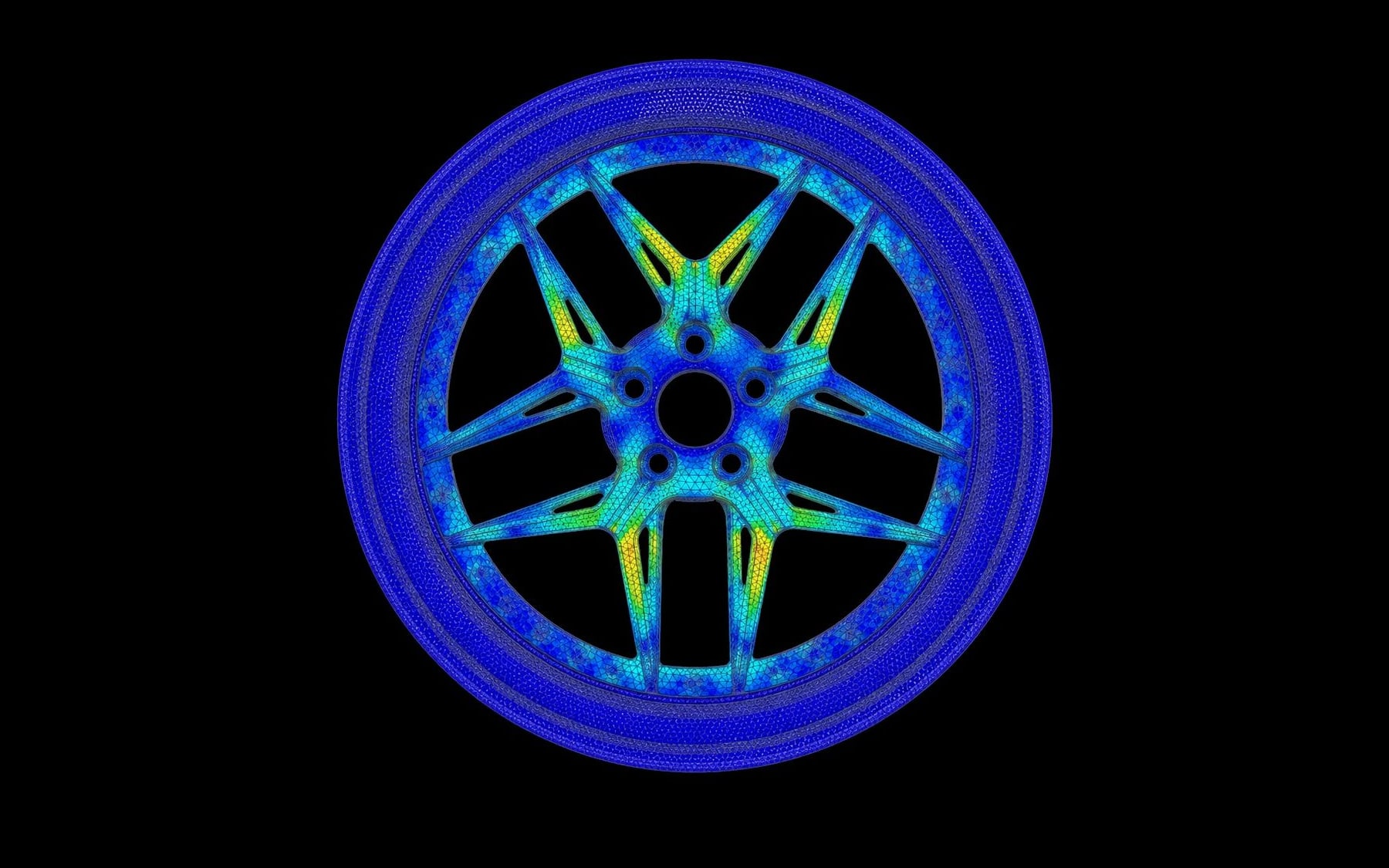
Each design is modeled in 3D against the specific vehicle it is built for — spoke geometry, face profile, barrel section, hub thickness, and brake clearance are all set against a real load case rather than a generic one.
The model is then put through finite element analysis: rotary fatigue, radial fatigue, and impact simulation. That tells us two things — where stress concentrates, and where material is sitting in the design doing no work at all. We iterate on both before committing to production.
Every design is engineered to meet or exceed JWL and TÜV standards. Solving the structural problem in software is what allows the finished wheel to be light without being fragile.
Finite element analysis. Color maps where load concentrates, which tells us where material is needed and where it is only adding weight.
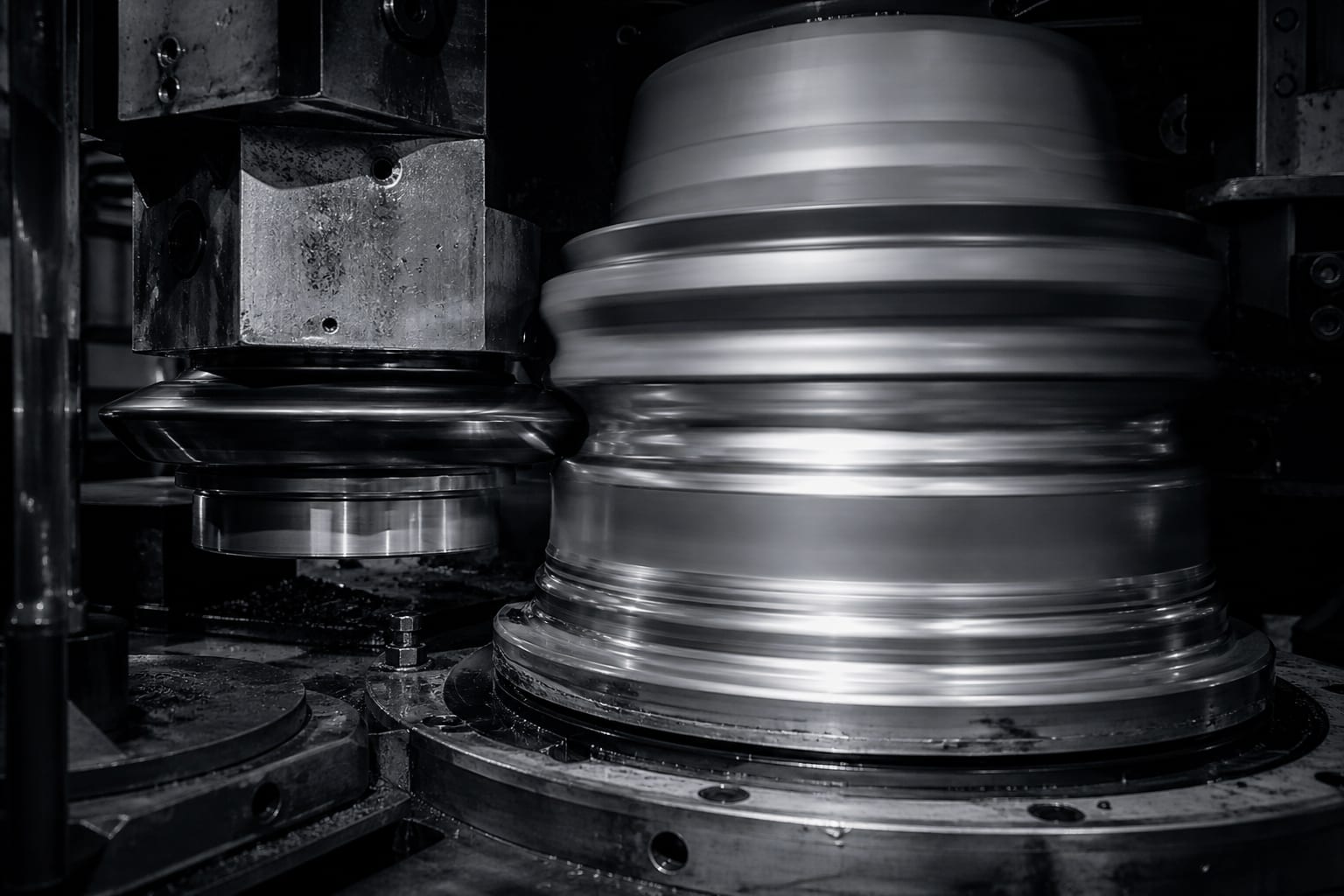
Barrel forming, in process
Phase 02
Material & Forming
Forging is a process of compression, not pouring. This is the phase that gives a forged wheel its fundamental advantage over anything cast.
4 stages
02
Material & Verification
Production starts with solid 6061 aluminum bar stock. Before it enters the process the material is checked for internal voids and inclusions and its chemistry is verified against specification.
This matters because nothing downstream can fix bad metal. A flaw found here costs a length of bar; the same flaw found after machining costs a finished wheel — and if it is never found at all, it costs considerably more than that.
03
Sectioning & Pre-Heat
The bar is cut into individual slugs sized to the diameter and width being produced. Each slug weighs a great deal more than the wheel it will become, which is the nature of subtractive manufacturing.
Slugs are brought up to forging temperature in an oven so the aluminum will flow into the die under load rather than tear or fold.
04
Forging Under Pressure
The heated slug is loaded into a die and compressed by a forging press. The forces involved are closer to minting a coin than to casting a part, and two things happen simultaneously.
First, any porosity in the aluminum is closed. Cast wheels start as molten metal poured into a mold, and cooling molten metal traps gas — microscopic voids that become the point where a crack starts. Compression removes them, leaving denser material throughout.
Second, the grain structure of the metal is reoriented to follow the shape of the part instead of running randomly through it. Aligned grain is the entire reason a forged wheel can carry the same load as a cast wheel using less material. What leaves the press is a blank: recognizably wheel-shaped, still heavy, with a thick bell-shaped barrel.
Cast — porosityForged — void free
The same alloy at magnification. Gas trapped as a casting cools leaves voids behind; pressure in the press closes them, which is what makes forged material denser all the way through.
05
Barrel Forming
For monoblock wheels, the barrel section of the blank is worked against a mandrel under pressure and spun out to the final width for that fitment.
Working the metal this way densifies the barrel and aligns its grain radially — strength placed exactly where the barrel takes the highest cornering and impact load. The profile the barrel is drawn to also determines caliper clearance, so it is set per fitment rather than to a single generic shape.
CNC face machining, in process
Phase 03
Machining
The blank now contains the strength. Machining is the process of removing everything that is not contributing to it — and this is where the hours go.
4 stages
06
Lathe Turning
The blank is mounted on a lathe and cut from both front and rear to establish the barrel profile and the basic two-dimensional spoke section.
This is the single largest material removal of the entire process — a substantial share of the blank’s weight comes off here. What remains is a balanced foundation with material still present everywhere the design needs it, prepared for top-down machining.
A blank on the lathe. The barrel profile and the basic spoke section are established here, before the face is ever touched.
07
In-Process Inspection
Before anything moves to milling it is inspected and measured. Imperfections are identified and addressed at this point rather than discovered later.
The reasoning is straightforward: rejecting a turned blank costs a blank, while rejecting a wheel after eight hours of CNC time costs a day of machine capacity. Only wheels that pass continue.
08
CNC Face Machining
The wheel is fixtured in a CNC machine and the face is cut to its finished form — spoke shape, concavity, hub face, bolt circle, and center bore.
Toolpaths are written per design and per fitment, and each wheel is machined individually. On an intricate face with deep spokes this stage alone can run up to eight hours for a single wheel.
09
Side-Milling
A ball cutter then works into the flanks of each spoke, taking a plain rectangular section down to an I-beam or channel profile.
The logic comes straight out of the simulation work in phase one. A spoke carries load through its top and bottom faces; the material in the middle of the flanks contributes far less. Cutting it away sheds weight without touching the structure that does the work, and the FEA tells us precisely how deep we can go.
It is slow, it consumes tooling, and it is expensive to do properly — which is exactly why it is often skipped. It is also the difference between a wheel that is genuinely light and one that is simply thin. The wheel reaches its final weight here.
As machinedAfter side-milling
Side-milling turns a rectangular spoke into an I-beam section — weight comes out of the flanks, stiffness stays in the load path.
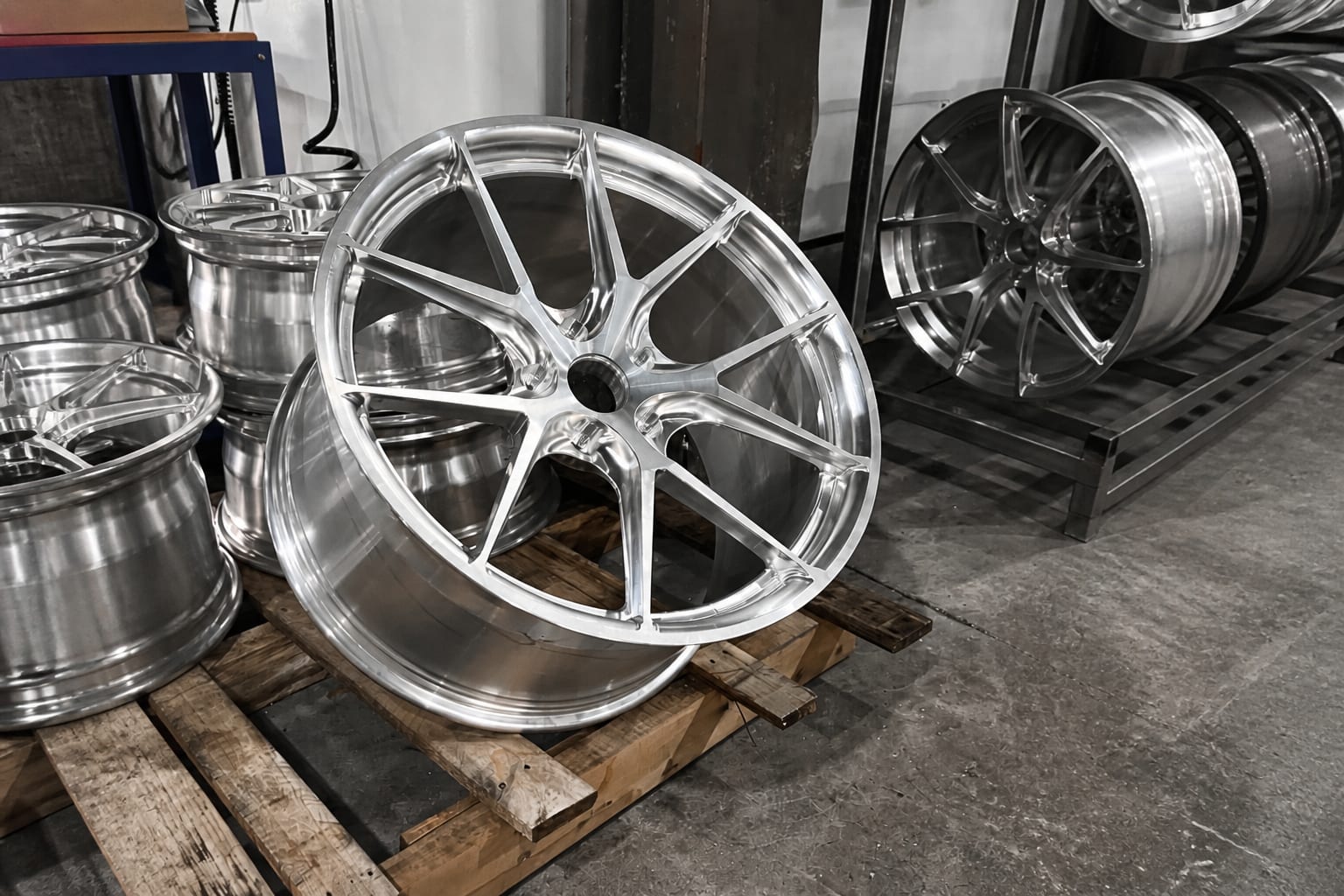
Finished set, before packing
Phase 04
Finishing & Delivery
The structural work is complete. What follows determines how the wheel looks on the car and how well it survives its first winter.
7 stages
10
Surface Preparation
Every edge is hand-filed and every burr removed, then the surface is brought to a uniform texture through buffing and ceramic brushing.
This stage takes longer than most people expect, and it is not cosmetic housekeeping. Coating amplifies whatever sits beneath it — a finish can only ever be as good as the surface underneath, and an inconsistent prep shows up as an inconsistent gloss months later.
Machined and bare. Everything from this point on is surface work.
11
Coating
The wheel is coated to the specification ordered: a solid powder coat, a tinted coat worked over a prepared metal surface, or a high-gloss treatment, across the full standard and custom color range.
Mounting surfaces are kept clear of coating so the wheel seats metal-to-metal against the hub. Coating build-up in that area affects how the wheel clamps, so it is masked deliberately.
12
Hand Brushing & Polishing
Brushed and polished finishes are applied by hand. A technician follows the contours of the face to lay a consistent directional grain, or works the surface up to a reflective polish, before it is sealed under clear.
There is no machine shortcut for this on a detailed face — the curves and undercuts have to be worked individually. That labor is the reason these finishes carry an upcharge, and the reason no two hand-finished sets are perfectly identical.
13
Marking
Diameter, width, offset, and part identification are applied to the wheel so the specification travels with the hardware.
It reads as a small detail until three years later, when someone needs to confirm fitment before ordering tires, verify a set before resale, or match a replacement to an existing wheel.
Alloy, diameter, width, and offset, marked where they stay with the wheel for as long as it exists.
14
Assembly
Multi-piece and two-piece sets are assembled at this point. Hardware is torqued to specification using high-precision electronic torque wrenches and the assembly is sealed.
Center caps, valve hardware, and any center-lock components are fitted here so the set arrives ready to mount rather than as a box of parts.
An assembled multi-piece set. The perimeter hardware is torqued and sealed before the wheel leaves the bench.
15
Final Quality Control
Finished wheels are checked for runout and balance, measured against the ordered specification, and inspected under light for cosmetic flaws.
This applies equally to monoblock and multi-piece construction. Anything outside tolerance does not ship — it is remade.
16
Packaging
Each wheel is individually wrapped, the face is shielded, and heavy foam rings are fitted around the rim before the set goes into heavy-duty cartons with custom inserts.
It is the least glamorous stage of the process and one of the most consequential. A wheel that spent eight hours in a CNC machine can be ruined by a single careless handoff on a freight dock.
Straight Answers
Questions Worth Asking
Some of these work against us commercially. We would rather you buy a wheel understanding what you are buying.
No — and this is worth being direct about. Forging is a manufacturing method, not a performance rating. It raises the ceiling by letting you reach a given load rating with less material, but the design still has to be engineered to use that headroom. A cast wheel that was engineered properly will outperform a forged one that was not. Plenty of brands lean on the word “forged” as shorthand for strong while quietly cutting load ratings, stiffness, or testing. Treat forged as the starting point of the conversation and ask what the load rating is, what standard it was designed to, and how stiff the spokes actually are.
Only if nothing was given up to get there. Unsprung and rotating mass is absolutely worth chasing — it improves acceleration, braking, steering response, and how well the suspension controls the tire. But a wheel that flexes under cornering load costs you more in grip and feedback than the weight saving returns, and a wheel that fails costs you the session or worse. Load rating and stiffness have to hold while weight comes down. That is the actual engineering problem, and it is why a spec sheet showing only a weight figure is telling you less than half the story.
In the United States, not in any meaningful way. There is no mandatory testing regime for aftermarket wheels and no body actively auditing manufacturer claims, which means published specifications and performance figures ultimately rest on the seller’s word. Japan’s JWL standards and Germany’s TÜV standards do define real, specific test criteria — which is precisely why we design to them rather than to the absence of a domestic requirement.
Every design goes through iterative finite element analysis before production — rotary fatigue, radial fatigue, and impact simulation — and is engineered to meet or exceed JWL and TÜV standards. Wheels are then inspected at multiple points during manufacturing rather than only at the end, so a problem surfaces at the blank stage instead of on a finished set. Simulation is a design tool and not a substitute for judgment, so if you want the specifics behind a particular design at a particular fitment and load, ask us and we will walk you through it.
Because nothing about the process is held in stock. Your wheels do not exist as inventory waiting to be picked — a billet is cut, forged, and then machined to your diameter, width, offset, and bolt pattern specifically, before being finished in the color you chose. The machining alone can run up to eight hours per wheel, and hand-applied finishes add more. Made to order is the reason the fitment is exactly right, and it is also the reason it is not next-day.
More on ordering, fitment, and lead times in our full FAQ.
Next Step
Ready To Build Yours?
Every set is made to order. Tell us your vehicle and target fitment and our team will handle the rest.